Conversation No. 007
The 100 Year Conversation
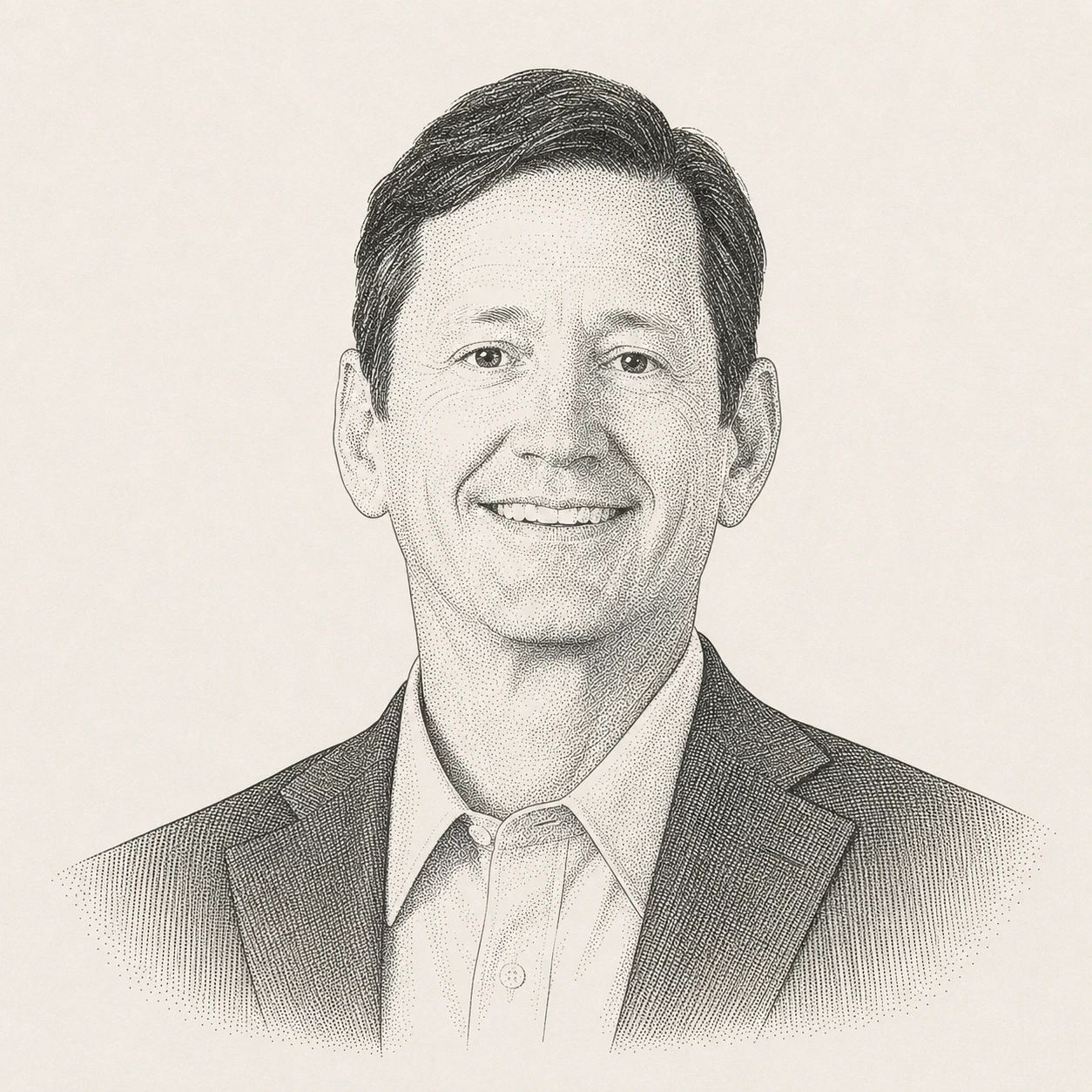
In Conversation with Wayne Peacock
Crisis, continuity, and stewarding USAA into its second century.
In this conversation, Wayne Peacock, former CEO of USAA and steward of one of America’s most trusted institutions, reflects on a career built entirely within one company: from learning the institution across ten different roles to leading it through one of the most consequential moments in its history. He explores the advantages of growing up inside an institution, what it meant to become the first civilian CEO in USAA’s history, how to preserve culture through change, and how member ownership shapes long-term decision-making.
This conversation was recorded in November 2025.
In 1988, Wayne Peacock, an economics graduate from Tulane University, joined a small real estate subsidiary of USAA. Thirty-six years later, he left as the CEO of the company he had spent his entire career helping build.
Over his career, Peacock worked in nearly every corner of USAA. He ran call centers, technology, strategy, marketing, security, real estate, and eventually the company’s largest business, its Property & Casualty Insurance Group. By the time he became CEO, there were few people who understood the institution more completely.
In February 2020, Peacock became president and CEO of USAA, the century-old financial services company founded by twenty-five Army officers who couldn’t get insurance elsewhere and decided to build their own. He was the first chief executive in the company’s history who had never served in the military. Weeks after he began the job, the world shut down.
Peacock suddenly found himself leading tens of thousands of employees through a global pandemic while serving millions of military members and their families during one of the most uncertain moments in recent history.
He never hopped from company to company. He spent nearly four decades learning one institution from the inside — ten jobs, one mission. The timeless lesson of Wayne Peacock is that stewardship is a discipline: earn trust over decades, preserve an entrepreneurial culture inside a hundred-year-old company, and understand that taking care of people is not separate from good business. It is the foundation of it.
On Becoming CEO During COVID
Gaurav Ahuja
Let’s start with the COVID moment. It’s February 2020. The world is about to shut down. You had just become CEO.
Wayne Peacock
Yes. I actually became CEO on the first of February, thirty-something years into my career at USAA, thinking, “Okay, I finally got my shot. Here are all the things I want to do.”
I think the stock market peaked on the nineteenth of February, if I remember my history. The next week, there were signs of whatever this was starting to percolate across the globe. A couple weeks later, we were full-on into it. So I literally went from day one of “you’re the CEO, let’s get rolling on a strategic agenda” to immediate crisis.
Earlier in my career, I ran business continuity, and we built the bird flu plan. So when this pandemic became maybe not real yet, but about to become real, it was: “Hey, go get that bird flu plan that we built a few years ago and let’s see what it says.”
The plan said that once 25% of employees were sick, we’d move to social distancing in the office. I’m glad we had a plan to start from, but this plan had not survived contact with this enemy.
I remember it was a Tuesday, and I brought my IT leader in. I said, “I want to send 10,000 people home so we can test our capabilities for this. Come back tomorrow and tell me what it’s going to take.”
He came back the next day and said, “In about three weeks we’ll be ready.”
I said, “Well, we’re going to send 10,000 people home on Monday, so you’ve got to figure out how you’re going to do that.”
We sent 10,000 people home on Monday. The next Thursday, we made the decision to send all 30,000 people home. There was no playbook. There was a gut reaction to what you need to do. You’ve got to make the best decisions you can in the moment.
Thankfully, in this particular case, Michael Dell was awesome because he basically drop-shipped equipment to us. Our USAA headquarters is the size of the Pentagon. It’s five million square feet. So there were plenty of places for drive-through areas. We literally set up drive-through stations for employees to come in from home, pick up their workspace computers, and go back home and get plugged in. Within two weeks, we did not miss a beat serving members every single day.
So that was the beginning of my tenure as CEO. A couple weeks into the job, I was facing probably one of the biggest challenges or crises anyone has faced in a while.
Gaurav Ahuja
It feels like there were two different worlds of enterprise response during COVID. In the startup world, people were already on Slack and Zoom. Everyone was on a laptop, not a physical PC in the office. You didn’t have to onboard people onto a bunch of different IT systems. I imagine that was not the case for you.
Wayne Peacock
We had about 25% of our folks at that point who had some type of at-home capability, but it was very rudimentary.
I think what has come from this is the spirit of innovation and change. Today, for folks who are on a headset talking to one of our members three or four days a week, we have basically built a pack with two or three wires that you unplug from home and plug back into your screen at work.
That resiliency has eliminated the need for any type of plan that says, “Hey, if this happens, how many people are you going to send home or how are you going to do social distancing?” Because everyone in the company now is mobile in that regard.
That’s to me one of the great lessons: invention comes when you have to. What we did to serve that particular need actually created new capability that we probably never would have built, or that would have been a long time coming.
Gaurav Ahuja
You were excited to be CEO. Maybe you had a strategic agenda ready. Then this happens. How did it feel?
Wayne Peacock
It wasn’t a punch in the face. It was, “Okay, what are we going to do?” But then it was almost invigorating. How are we going to get this done?
I took a playbook from one of my predecessors, going back to the global financial crisis. Let’s reduce the agenda to what matters most.
A, take care of employees, so everyone knows that as crazy and uncertain as this is, USAA is going to take care of you in this period of time.
B, I need you guys to lean in and take care of our members really, really well.
C, those of us sitting at the top of the house have to make really prudent financial decisions during this period of time.
Those three elements were about controlling what you can control. We had to stay focused on what mattered: take care of our teammates, deliver on the mission every day, and keep the financials in strong order.
I got to this place of: this is not going to be a fun time, and my job is to solve problems. The real question every day is how big the problem is, not whether there will be problems.
I also drew upon Admiral James Stockdale and what he wrote after being a prisoner of war, what has become known as the Stockdale Paradox.
The Stockdale Paradox is the ability to hold two truths at once: that this is a really terrible situation and, on the other hand, that there is hope we will get through it. In his view, that duality helped him survive an incredibly tough environment.
That’s what we brought into the environment. These were going to be tough times, and if we controlled what we could control and did that really well every single day, we were going to come out on the other end really, really well.
On Blue Time
Gaurav Ahuja
How did you make time to think about broader strategy while you were fighting the fire?
Wayne Peacock
I’ll put this in the category of the personal discipline of being in the role. It is one of the hardest things to do: to manage your time well and to take the time necessary to do the reflection, the thinking, the “where are we going down the road,” while you address the challenges of the day.
Because the reality is, in jobs like these, you could go without any plan for your day and show up at your office and just wait for people to bring you problems, and your whole day would be filled up.
My staff called it blue time. We put blocks on the calendar twice a week when no one could interrupt me. Those were the times when I got out of the fray and could think ahead. It is easy to infringe upon those time blocks. What it took me a while to learn is that you can’t do that in fifteen-minute increments or half-hour increments. You really have to set aside a block of time where you can concentrate.
Gaurav Ahuja
What did you use that time for?
Wayne Peacock
It was really about the big issues in front of us: How ready are we? What needs to change in our strategy to accomplish that? I used the time that way, or for important reading I needed to do.
I worked really hard for it not to be, “Here’s the next meeting I have to go to,” but the reading to get ahead or the reading to improve my knowledge. It really has to be your time as CEO to be prepared for tomorrow.
You can get yourself totally crazed by the details of today’s crisis and miss the things that matter most. Staying above the fray is an important duality to this as well.
One of the other things I’d say I got generally right, though not perfectly, was taking care of my physical well-being. These are tough jobs, and they’re always on. Especially as you age, you’ve got to maintain your physical stamina in order to keep your mental acuity where it needs to be to play at the pace these jobs require.
On Scouts, Family, and Standards
Gaurav Ahuja
You were an Eagle Scout. Did that shape you in a way that still lasts today?
Wayne Peacock
Absolutely. For me, there really was no seminal moment. I think of it more as standard-setting in the formative years that laid the foundation for who I am.
I think about the Scout Law of being trustworthy, loyal, helpful, friendly, courteous, et cetera, as the standards by which you conduct yourself every single day.
I think about the Scout Oath as really about the pursuit of excellence, as I would translate it as an adult. It basically says, “I’m going to do my best every single day.” This pursuit of being better tomorrow than you were yesterday, I think came from that.
And then there’s this idea of doing a good turn every single day, even if it’s a simple thing of helping someone.
What’s interesting to me is that the patrol environment of the Scouts is no different than how the Marines think about the basic unit of war, and now how we’re thinking about American business as well. None of us succeed as individuals. Small teams are how you get stuff done.
So maybe the Scouts were a little bit ahead of themselves in their view of what was important.
Gaurav Ahuja
What else from childhood shaped you? I’m curious about your parents. What did they emphasize, and what were the standards in the household?
Wayne Peacock
My dad went to work every single day and worked really long hours. But he did commit time on the weekends to be with us. He was never into athletics or those types of things, but he was there, at least through the scouting program. What he was, was maniacal about work ethic, truthfulness, and integrity. That got role-modeled and hammered into us as kids growing up. In some cases, he was almost brutal in how he could tell the truth about things. Hopefully I found a way to tell the truth about things with a little more grace associated with it, but those were really strong values.
My mom was the extrovert of the family, the salesman of the family. Probably helped a bit in my promotional skills as well.
My dad got transferred when I was in third grade to a different city, so I moved in third grade and then lived in the same place growing up. I contrast that with Ginny, my wife, who had six duty stops before fourth grade. Her dad was in Vietnam twice before first grade. Her mom had four little kids at home while dad was in Vietnam. You understand the pressures on military spouses as well, and the sacrifices they make. She had a very different upbringing.
But in our household, if you were to ask my friends growing up, they would say, “Wayne Peacock was the guy who couldn’t come out on Saturdays until he got his chores done.” That would be a good way to describe the standards by which we lived in the Peacock household.
Gaurav Ahuja
So it wasn’t just work ethic about school or about his job. It was work ethic about everything.
Wayne Peacock
Let’s put it this way. My dad had two Model Ts when he was growing up. He only had enough parts for one of them, but he drove both of them, depending on which week it was. So that gives you a little bit of a sense of his fastidiousness.
Gaurav Ahuja
You said he could be brutally honest. What did that mean?
Wayne Peacock
I think it starts with being really clear: did I meet my mark today? And if not, what do I need to do about it?
If you can hold yourself to those high standards, then you have an opportunity to both be a role model and set standards for those around you.
We had an event the other night. I was up at Hiring Our Heroes, and they recognized my leadership. My son was there, and what he told them was, “If you can hang with my dad, he will make you better.”
That’s probably a kid’s slang way of putting that into context for you.
On Mission, Values, and Building a 100-Year Institution
Gaurav Ahuja
USAA is already a 100-year company. What allowed it to last?
Wayne Peacock
It starts first with mission and purpose and clarity about what it is we do. We’ve done it differently over a hundred years, but we were very clear in the beginning that we help military families, and we’re very clear a hundred years later that we help military families. How we help them, the way we go about it, is radically different. So I think that is number one. Number two is really about standard setting, values, however you want to frame it up. It’s about how we behave in delivering on the mission every single day. The third piece is really about the prudence with which we run the company to achieve the mission while upholding those standards. There’s an interrelationship between those three themes.
But if you step back from all of that, I think what has enabled us to be successful with that as a foundation is this relentless focus on the military community and their needs, and how to meet those needs better tomorrow than we did yesterday.
There has been this relentless pursuit of understanding their lifestyle, understanding their life issues, layering those on top of the norms of what we do in terms of financial products, and then tailoring with product design and experience in a way that is more relevant for a military member than for the typical civilian out there.
That drive to put the member in the center and to continue to innovate, not because we’re guessing or thinking about them, but because we’re engaged with them and doing research around what’s most important, has enabled us to add products over time, to add channels of engagement over time, to truly become a design-centric organization, and to build what we do from the member out as opposed to from the company out.
If you go back to 1922, we provided auto insurance to 25 Army officers who couldn’t get it elsewhere. And then we got really crazy in 1923, and we let the Navy in.
If you come back to clarity of purpose, standards of excellence, and this relentless desire to be better tomorrow than we were yesterday, it’s allowed us to innovate and change and grow while not losing sight of who we are and what we stand for.
Gaurav Ahuja
USAA expanded in two directions: who it served and what products it offered. How did you know what was a natural extension of the mission, and what risked going too far?
Wayne Peacock
That’s the tension point.
We start with just Army officers, then we add other officers, then we add officers’ grown kids, and then we reach a very significant inflection point in 1996.
I give General Herres tremendous credit for this because it was not the most popular thing to do at the time. If we truly believe in the mission of helping military families, and we understand who puts themselves in harm’s way when we go to war, or even when we go downrange, enlisted folks are the folks doing the work of the work, who are defending our freedom out there.
That decision to move from just officers to enlisted was, to me, one of the most important but tension-filled decisions on the expansion of access.
We did that to manage growth and manage capability to actually serve. In 2009, we said that if you ever honorably served, if you were enlisted prior to that 1996 date, you were eligible to join as well.
There are some DOD contractor communities on the fringe that feel much like active-duty service members that fit that ethos. But the further out you go from there, you start to dilute the specialness of the association and the sense that we truly know who you are. You get closer and closer to gen pop, and I think we lose our distinctiveness.
We’ve had folks come from Italy and England and other places and say, “Can you come do this for the military in our country?” And then there’s the natural next step out to first responders and folks who are kind of in the community.
We’ve said, no, we’re going to stick to our knitting.
On the other axis, this really comes back to: what do our members need? Can we provide it to them with excellence? And can we do it in an economically viable way for the strength of the association?
Since the beginning, we have said auto insurance can go to homeowners insurance. We can add credit cards. Could we add checking accounts and primary bank relationships? Can we add life insurance? Can we add investments? I think those are all very natural adds to the equation.
We exited a few businesses a few years ago. To come back to those filters I talked about earlier: do our members need it? Can we do it with excellence? Can we do it in a way that meets the financial criteria for the association?
What we recognized, based on earlier decisions, is that we could not build from where we were in the investment space, given what was happening in the marketplace, and do right by our members and build a machine that was economically viable.
That’s why we decided to partner with others to provide that service. That may or may not be the reality in the long run, because markets change and technological advances come along. But that was the choice there.
On Member Ownership
Gaurav Ahuja
USAA is member-owned. It’s not a traditional shareholder-owned company, and it seems central to how the institution thinks long term. How does that affect the way the company operates?
Wayne Peacock
I think if you manage a mutual well, it is a highly preferred structure to operate a company.
First and foremost, the alignment between stakeholders is easier because your customers, members in our case, and your shareholders are essentially one and the same. So you have one fewer set of stakeholders who may find themselves at odds, or where management may find itself with tension between them. The ability to take a longer-term view of capital planning and strategy, without being subject to quarterly earnings, is a huge advantage as well.
But you have to operate it well, because one of the negatives is your ability to raise capital. You can see our financial results. Pound for pound, there’s no one in the insurance space who is as strong as USAA is today. But every dollar of capital came from one place, and that’s retained earnings. You don’t have the ability to go out and raise new equity. We are very prudent about using debt and leverage in the company as well.
So you’ve got to run your operations really, really well in order to provide the right earnings power to deliver dividends back, reinvest in capabilities, and manage capital strength.
When you overlay on top of that the business we’re in, especially in insurance and homeowners, when bad weather comes, there’s a lumpiness to your capital requirements. You’ve got to maintain a very strong capital base to absorb what may come your way when the wind blows or the fires burn.
I think it is a very magical place to be if you manage it really, really well, and it’s part of the secret sauce of USAA.
Gaurav Ahuja
You returned a billion dollars in dividends to your members. Can you frame that decision?
Wayne Peacock
From a personal standpoint, this was fairly early in my tenure. We probably debated this for about a week. One night, I realized that no one but me was going to make that decision. I was watching what was happening and wondering whether a division president was going to say yes to this. And then I realized, no one is going to make this decision but me. That was a real big epiphany.
Gaurav Ahuja
There’s no personal benefit, from a career standpoint, to being the person who signs up to give away a billion dollars.
Wayne Peacock
Yes. And everything that comes along with that. Even in our large organization, that is a big number.
That was an epiphany that came to me that night, but it was also a good mark for me going forward of what are the decisions only I can make or should make? And am I spending my time appropriately in that space versus the things others can be doing?
But back to the point here: people were not driving, cars were not crashing, and we were not spending as much on claims as we had planned for, which is why we had the ability to send that money back.
It set a big precedent. There was a lot of discussion with the board about whether our balance sheet could handle this at the end of the day.
What we came back to, which is what I love about USAA, was: what’s the right thing to do in this mission-based organization? Take care of your members.
The reality is they paid premiums, and we expected the cost to be X. Costs were less than that. It was right to return that money to them.
When it was time to go, it was about four o’clock one afternoon. I said, “We’re going to announce this before the market opens tomorrow morning,” because we also knew at that point others were thinking through this.
That’s back to COVID speed, where the whole apparatus that had been debating for a week said, “We can’t be ready in the morning.” And I said, “Well, we’re going to announce in the morning. So let’s figure out how to be ready to go.”
It was amazing what happened. Once you declare, “We’re going,” the ability to do all the analysis and put all the pieces in place becomes a whole lot easier than when you’re debating whether you should or should not.
We were able to announce the next morning before the market opened.
On Technology as an Enabler
Gaurav Ahuja
USAA has been early to many technology waves, from toll-free phone service to online banking to mobile. For a company founded in 1922, where did that culture come from? Was there always a belief that when a new technology emerged, USAA needed to be there early?
Wayne Peacock
I would go back to General McDermott, who led the company for 25 years and was a visionary in so many ways. He set the stage in the early days with IBM, bringing technology into the insurance space. He planted the DNA seeds back in the 1970s.
He also made the decision to bring the bank into the environment, as well as the investment business. His view of how do we create this financial supermarket to help military families across all of their financial needs was really the blueprint for where USAA is today.
Gaurav Ahuja
Given that this was prior to the PC era, what were you doing with IBM?
Wayne Peacock
We started by trying to get the whole office paperless. IBM mainframes came in, with COBOL programming to build out our insurance operating systems, some of which we are still working our way through.
He really set that vision, and the DNA existed. But then, as we recognized what was happening with technology and financial services, the question was: how do we use technology to drive more value for our members?
The complement to that was that most military folks at that point in time were actually more savvy with technology than the average consumer. Their willingness to adopt was higher than the average consumer. And they were being moved on a regular basis, so the ability to do things long-distance mattered a lot.
As the internet was coming forward, I remember so clearly we talked about it as brochureware. The question was: how do we get from brochureware to actually being able to do transactions?
We were very committed early on that we wanted to be able to have people buy without actually having to talk to a person. We were also very committed that, when they wanted to talk to a person, they could, and that person would be well-trained and available immediately.
This combination of great people and great technology became the hallmark for the experience we were going to deliver.
Gaurav Ahuja
That’s interesting because being at the forefront of these technology waves wasn’t born out of, “We need to be at the forefront of technology.” It was born out of “Our members have unique lifestyles. They move a lot. They need to be able to self-service. How do we enable that?”
Wayne Peacock
Well said. It was the enabler.
We are a very innovative company, but what drives that innovation is a deep, relentless focus on our members and their needs.
As we moved into mobile, and this is before the iPhone came out, we actually had sailors on board ships in low-bandwidth environments who were practicing our rudimentary mobile banking capabilities. Not from a mobile device of their own, but from a low-bandwidth desktop on the seventh deck of a destroyer somewhere in the Pacific.
We took that type of insight as we began to build out our early mobile capabilities. We made multiple bets on three different rails. Then the iPhone came out, and the rest is history in terms of what was going to win from a channel rail and infrastructure perspective.
But along the way, the message was: we have got to be out front so that we can continue to serve our members really well.
When you think about it, today we have nine and a half million depositors at USAA. A few of them live in San Antonio, Texas, but most of them are scattered about the country and the world.
Gaurav Ahuja
Was that driven by fear of competitors and disruptors, or was it more about serving members better?
Wayne Peacock
What I would tell you is relentless focus on the members, a very keen eye on competitors, and a very high standard that being the best matters, but being better than the rest matters as well.
One of our big challenges is to fight complacency. I think most people would argue that in the financial services space, no one’s got better customer service than we do. But it’s not enough to be the best. You’ve got to be better than everyone else.
We also try to learn from what others are doing and bring that reality into the environment to fight complacency. The reality is, it’s easy to get complacent, and you’ve got to keep people motivated. One way you do that is around serving the member really well, and the other way is by talking about those who are trying to take our fair share of the market every single day.
If you were to talk to folks at USAA, you would not get a sense of, “We’re amazing. Let me tell you why we’re amazing.” You would hear, “Here are the areas where we’re not meeting the mark, and here’s what we’re doing about closing that gap for our members this month, this quarter, next year.”
We don’t boast about what we do well. We just go back to work on making tomorrow better than it was yesterday.
I think there have always been competitors in the marketplace. I think there are more competitors today, and better competitors today than there have ever been. The competition is clearly much better today. We talk about that a lot. But that just continues to raise the stakes of how fast we need to innovate and how much better we need to be going forward.
On Leadership Continuity
Gaurav Ahuja
Looking at the ten or eleven CEOs USAA has had, were most of them developed inside the company rather than brought in as outside hires?
Wayne Peacock
General McDermott came as the president and became CEO, and he came right out of the Air Force. General Herres came straight from the Air Force and worked at USAA for three years before he succeeded General McDermott. Bob Davis came after Herres, and he had probably three or four years of tenure in the C-suite before he became CEO. Joe Robles was the CFO for fifteen years. Stuart Parker was twenty years. And I was thirty-something.
So that takes you back sixty-something years.
Gaurav Ahuja
So there is still a lot of multi-decade context and knowledge in the leaders who take over.
Wayne Peacock
Yes. I think there’s a sense of continuity that comes from our military roots.
You’re not going to walk into this company and say, “We have a brand-new strategy. We’re going to serve civilians.” Or, “We’re going to have a brand-new strategy and the product set is going to look like X, Y, or Z.”
The good news is every CEO is going to put his or her stamp around the edges, but there’s not a huge pivot that goes on.
The values, ethics, ethos of the company, all of us have iterated and improved upon. But in so many ways, if you went back and listened to what General McDermott would say sixty years ago, it may not be that different from what I talked about the last five years at the highest level.
So I think that continuity really helps us as we transition leadership over the years.
Gaurav Ahuja
Is that long-term mindset reflected throughout the company, or has tenure changed as the company has grown?
Wayne Peacock
Probably today our average tenure is coming in line with Progressive. They’re not turning people over at the rate some software companies might. But our average tenure is less today than it was ten years ago.
There is a barbell of folks who have been there for a really long time and folks who have been there for a shorter period of time. That is the reality of changing demographics.
What we have done is probably brought more people in from the outside into the second and third tier ranks as we’ve scaled and the complexity of the organization has gone up.
Gaurav Ahuja
How planned have the CEO transitions been?
Wayne Peacock
The transition from McDermott to Herres was very planned, and the transition from Herres to Davis was very planned. There was probably competition post-McDermott, and Herres won.
Then it was really clear that Bob Davis would take over for General Herres. Two years before it was going to happen, we all knew Bob would be the next CEO.
Bob left very abruptly. Then Joe Robles took his place. We had a two-year process to select Joe Robles’ successor, and an almost nine-month overlap between Joe and his successor. Then his successor left abruptly, and I took over.
I announced my retirement in July of last year. The board was very transparent with the leadership team that we were going to go through a search both internally and externally. We made a decision in January, and from January to April we did left seat, right seat together. Then I stepped down in April, and he stepped in.
So, to me, that was a much more normal way to do it.
Gaurav Ahuja
You had thirty-six years at the company. Did you ever wonder what was on the outside?
Wayne Peacock
Yes. There was a point earlier in my career when I was being considered for the CEO role, and I was not selected. That was a really important time for me. I had to ask myself: if I want to be a CEO, do I need to leave right now?
But I cared so deeply about the mission and what we were trying to accomplish that I made the decision to stay.
I expected I would stay and do what I was doing, and then I would retire. Then, as fate has it, late in my career, I got the opportunity to actually step into the big seat.
I had ten different jobs at USAA. I talk to people a lot about why I stayed. One reason is knowing that what you do matters every single day and makes a difference to people who matter. The second is being intellectually challenged by the work. The third is being able to do it with like-minded teammates who are trying to make a big difference in the world. And I was intellectually challenged every three years for thirty years, literally. That’s about the time I was in just about every one of those roles. So I never felt like I needed to go somewhere else to be intellectually satisfied.
On Living Up to the Standard
Gaurav Ahuja
You were the first CEO without a military background. Did that ever feel like something you had to overcome, either growing up inside the company or once you became CEO?
Wayne Peacock
The common thinking along the way was that there would never be a civilian who would be the leader of USAA. So if you were a senior executive like myself, you knew you were there to deliver great value, but the chances of being selected were pretty close to zero.
Having said that, I spent a tremendous amount of time trying to understand military culture and military life.
I would never presume that I understand what it’s like to put on a uniform and go into harm’s way. I think that would be really inappropriate to ever think you could understand that.
But I have spent enough time talking, visiting, experiencing, and studying to say that I get the plight of folks who are in that situation.
I’ve seen it firsthand with my father-in-law, who came out of the military after twenty years, and his transition into civilian life. I listened to the stories of Ginny’s mom raising four kids while dad was in Vietnam and understood that intimately at home as well.
There’s a big gallery wall at USAA headquarters. It’s got a painting of every one of those CEOs. The morning I was to be announced as the new CEO, I went in early, and I just walked up and down that gallery wall, looking at all those ribbons and medals and all the accomplishments of all of these generals and colonels who had run the company.
I thought, “Oh my goodness, I have to live up to this standard going forward.”
But from a “what is it going to take to do the work of the work” perspective, I had been around this place longer than any of those folks ever were before they stepped into the seat. I had been playing at a high level in the company for a long period of time.
So I didn’t walk in going, “I won’t know what to do.” But I walked in very humbled to be in the company of all of those senior military leaders.
I think I built a reputation at USAA beforehand that people knew I cared deeply about our members, I cared deeply about our employees, and hopefully I made pretty good business decisions.
So I don’t think there was any significant internal view of, “He’s not a military guy. He’s not the right guy to run the company.”
But on the outside, there was definitely feedback from older members of, “We’ve lost our way — we have some civilian guy running the company.”
On Stewardship
Gaurav Ahuja
What advice would you give to non-founder CEOs trying to make their own mark without being overshadowed by the institution’s history?
Wayne Peacock
Here is how I think about it, and it may not be appropriate for every company.
How do you take where we have been, think about where we need to go, keep what’s good, adjust for the future, and then communicate clearly why we are making those changes?
I use the term stewardship a lot about these roles. No matter who you are, you’re not going to be there forever.
If you do your work really well, the entity not only survives you, but thrives after your tenure as well.
If you put yourself in service to the organization, I think that changes the frame of mind that you have about: am I an imposter or not? Can I do this or can I do that?
You’re actually helping the organization be its best self in the future. When you can speak like that, but also act authentically like that, many of those other issues fall away.
In my view, you have to celebrate where you’ve come from and take full advantage of all the strengths of where you’ve come from, and then build upon it for the future.
Walking in and saying, “Everything we did yesterday is bad. Here’s what we’re going to do in the future,” is never going to win over incumbent employees. But celebrating the past and utilizing its best strengths for the future is a much better way to play.
Whenever you can shift from “it’s not about me” to “it’s about how together we’re driving this organization forward,” the level of investment in the future goes up.
Get on the service road, accelerate up to speed, merge onto the highway, and then you can start to shape the flow and direction of traffic from there. But if you rush out and put a big stop sign out there, people are going to crash. It’s just a much more thoughtful and nuanced way to go about shaping the future.
And as a competitive sailor, I would tell you, if you aren’t underway, you can’t steer. Getting underway matters and being in the flow matters.
On the Next Hundred Years
Gaurav Ahuja
What does it take for USAA to last another hundred years? And what do you want to be remembered for?
Wayne Peacock
If we stay focused on taking care of military families, and we stay focused on what they need and providing it for them, and we hold ourselves to high standards, we have a huge opportunity to add value, to be of value to our members, and continue to be highly successful as a financial institution going forward. If we’re willing to continually innovate and change to meet the moment or meet our members’ needs, we have a chance to survive and thrive as well.
I don’t know exactly what that will look like. And I don’t think anyone could say those twenty-five Army officers envisioned where we are today with any level of clarity.
But I do know mission clarity and strong values will give us that opportunity. If we stay relentlessly focused on our military members going forward, we’ll continue to innovate and change and serve them really, really well.
You think about different products we can offer, but I think the real opportunity for us, no matter what shifts and changes, is to provide advice to help them make prudent decisions every single day. The delivery of products to fulfill that will come and go. But helping people make sense of the world around them, their financial world, and everything that is connected to that ecosystem, is where there is real value-add.
And I hope that down the road, when people look back at my tenure, they’ll clearly look at the challenges of the crazy environment and say, “We managed through some really challenging times.”
But I believe what they will also say is, “He is a person who put the company first and was relentlessly focused on members and their needs every single day.”
Hopefully, there will be a few people around who say, “You know, I’m a better leader today because I got to hang out with Wayne Peacock for a while.”
The opinions expressed in this newsletter are my own, subject to change without notice, and do not necessarily reflect those of Timeless Partners, LLC (“Timeless Partners”). More...
Nothing in this newsletter should be interpreted as investment advice, research, or valuation judgment. This newsletter is not intended to, and does not, relate specifically to any investment strategy or product that Timeless Partners offers. Any strategy discussed herein may be unsuitable for investors depending on their specific objectives and situation. Investing involves risk and there can be no assurance that an investment strategy will be successful. Links to external websites are for convenience only. Neither I, nor Timeless Partners, is responsible for the content or use of such sites. Information provided herein, including any projections or forward-looking statements, targets, forecasts, or expectations, is only current as of the publication date and may become outdated due to subsequent events. The accuracy, completeness, or timeliness of the information cannot be guaranteed, and neither I, nor Timeless Partners, assume any duty to update this newsletter. Actual events or outcomes may differ significantly from those contemplated herein. It should not be assumed that either I or Timeless Partners has made or will make investment recommendations in the future that are consistent with the views expressed herein. We may make investment recommendations, hold positions, or engage in transactions that are inconsistent with the information and views expressed herein. Moreover, it should not be assumed that any security, instrument, or company identified in the newsletter is a current, past, or potential portfolio holding of mine or of Timeless Partners, and no recommendation is made as to the purchase, sale, or other action with respect to such security, instrument, or company. Neither I, nor Timeless Partners, make any representation or warranty, express or implied, as to the accuracy, completeness or fairness of the information contained in this newsletter and no responsibility or liability is accepted for any such information. By accessing this newsletter, the reader acknowledges its understanding and acceptance of the foregoing statement.